
How to File a Pollution Complaint in India That Gets Action
 TBH Editorial
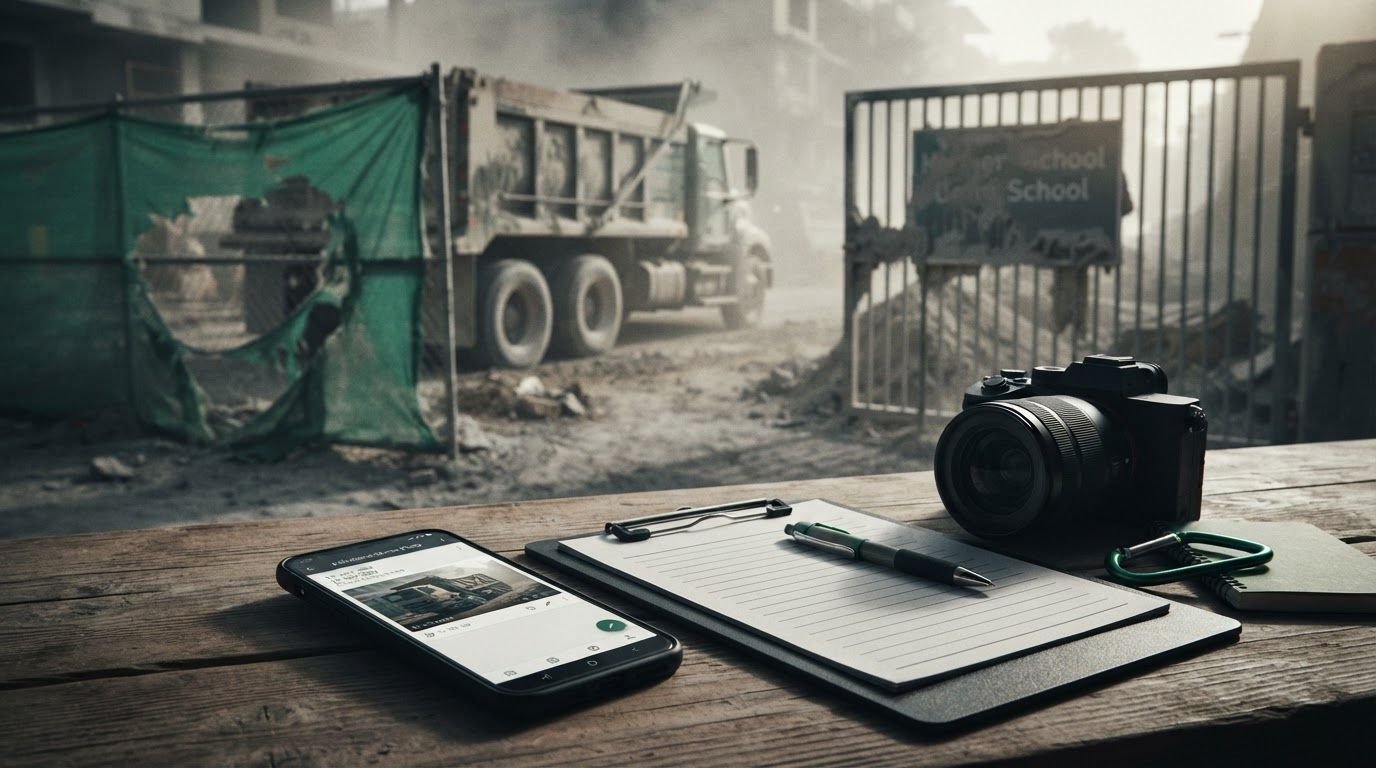
The photo that gets a construction site inspected is rarely the dramatic one. It is the boring, time-stamped image of an uncovered truck, a broken dust screen, or grey residue settling on a school gate.
An effective pollution complaint India residents make isn’t a rant into the void. It is a clear record that tells an authority what happened, where it happened, who may be responsible, and what needs inspection.
You don’t need a lab coat or a legal degree to report visible air pollution. You need observable facts that are hard to dismiss, not unsupported scientific claims.
Key Takeaways
- Build an evidence-based pollution complaint with dated photos or videos, exact locations, repeated exposure details, source information, and the people or places affected.
- Send the complaint to the authority with enforcement power: usually the State Pollution Control Board or Pollution Control Committee for construction, industrial, and recurring burning issues; municipal bodies for waste and sewage; and police or designated authorities for ongoing noise.
- Write the complaint as an inspection request, ask for action during active hours, and save every acknowledgement, reference number, attachment, and follow-up.
- Use CPCB’s EPR support system only for portal and registration problems, not for reporting field pollution such as smoke or wastewater.
- If authorities ignore a documented complaint, escalate through CPGRAMS, use RTI to request inspection and action-taken records, and consider formal environmental remedies only after preserving the administrative paper trail.
Before You File, Turn Exposure Into Evidence
Don’t wait until you can prove every chemical in the air or water. Most residents cannot test particulate matter, wastewater, or industrial emissions themselves. Your role is to document the visible source, the pattern, and the people exposed.
Road dust, for example, is a common source of air pollution, not plain soil. It can carry cement fines, diesel soot, tyre fragments, brake wear, ash, and debris from broken road shoulders. Traffic then crushes and lifts that material back to breathing height.
Photograph What Leaves the Site
A good complaint shows pollution leaving the source and entering a shared space. Stand on public property, stay safe, and never confront workers or enter a restricted site.
Build a simple case file:
- Record the date, time, weather, and how long the activity lasted.
- Save the exact location, nearby landmark, ward, or map pin.
- Photograph uncovered debris, smoke, dry cutting, open burning, or trucks without covers. Capture water pollution such as sewage, wastewater, foam, or discoloured discharge, along with dumping or unmanaged debris that can show recurring waste management failures.
- Capture the wider setting, especially homes, shops, bus stops, trees, clinics, or school routes nearby.
- Write down the company name, project board, vehicle number, or factory name if it is visible.
- Keep copies of earlier emails, complaints, and replies in one folder.
A single photo can be brushed off. Ten images taken across three weeks show a pattern. Video can help too. A short recording can document noise pollution from loud machinery or generators, smoke plumes, or a truck spilling material onto public roads.
Tell the Story of Repeated Exposure
Don’t write, “The air is terrible.” Write what people are breathing and when.
For example: “Dry concrete cutting takes place beside the eastern gate between 8:00 and 10:00 a.m. Dust settles on the footpath used by students and street vendors.” That gives an officer a time window for inspection.
A citywide air-quality number may not show what a tea seller, security guard, delivery rider, or child breathes beside one active gate. Local exposure depends on distance, time, wind, and how often pollution returns. Repeated activity at the same site can show ongoing compliance issues, even if you cannot identify every pollutant.
Pollution Complaint India: Choose the Authority That Can Act
A complaint sent to the wrong office can disappear for weeks. Match the source to the authority with enforcement power, and identify the regional office with jurisdiction where the pollution occurs.
| Problem | First route | Include in the complaint |
|---|---|---|
| Ongoing loudspeaker, DJ, generator, or machinery noise | Local police or the designated noise authority | Time, address, recordings, and whether it is still happening |
| Construction dust, factory smoke, industrial discharge causing water pollution, or recurring burning | State Pollution Control Board or Pollution Control Committee | Source details, photos, location, frequency, and affected area |
| Air pollution in Delhi-NCR | Central Pollution Control Board’s Delhi-NCR air complaint route | Location, pollution type, description, contact details, and photographs |
| Overflowing sewage, illegal dumping, or municipal waste burning | Municipal body and State Pollution Control Board/PCC | Photos, drain or road location, source, and repeat incidents |
For residents outside Delhi-NCR, the State Pollution Control Board or Pollution Control Committee is usually the main enforcement body. Use the Central Pollution Control Board’s official site to identify the relevant regional office and reach the correct state channel.
If you are in Assam, file through the Assam Pollution Control Board and check its current Public Grievance Officer listing for the relevant public grievance office. Names and contact details can change, so confirm the district regional office and current officer before sending your evidence.
For Noise, Call While It Is Happening
A noise complaint should not wait until the next morning. Call the nearest police station or designated authority while the noise pollution continues.
The Noise Pollution Rules allow designated authorities to act on violations. Depending on the state arrangement, this can include the District Magistrate, Police Commissioner, or an officer at least at Deputy Superintendent of Police rank. Police intervention matters because an ongoing noise pollution incident can be witnessed in real time and assessed against applicable noise standards.
Nyaaya’s guide to filing a noise complaint explains the available complaint routes. Before filing, verify that the relevant regional office has jurisdiction over the location. The Haryana Pollution Control Board’s noise rules also note that a complaint may be made when noise exceeds the applicable ambient standard by 10 dB(A) or more.
Submit a Complaint an Inspector Can Verify
A complaint becomes stronger when it reads like an inspection request, not a social media post. Put the core facts in the first few lines.
Write for the Person Visiting the Site
State the source first. Then state the harm, location, timing, evidence, and request.
- Identify the activity, such as demolition, metal cutting, waste burning, sewage discharge, or industrial smoke.
- Give the exact location and the closest landmark, school, market, hospital, or road.
- Explain when it occurs and whether it has continued for days or weeks.
- Attach dated photographs, videos, and earlier correspondence.
- Ask the relevant regional office for a site inspection during active hours and a written outcome on corrective action.
Avoid guessing that an emission is “toxic” if you cannot verify it. Describe what you observed. For noise pollution, record the location, active hours, affected people, and a dated recording. Thick black smoke, a chemical odour, dust on food carts, foam in a drain, or ash on nearby leaves are also useful observations.
Save Every Reference Number
Once you submit, save the acknowledgement number, screenshots, attachments, and date of filing. If the portal gives a tracking number, treat it like a receipt.
Follow up in writing if no meaningful update arrives. Send it to the regional office with jurisdiction over the site.
A short message works: “Please share the inspection date, inspecting officer, findings, and action taken on complaint reference number X.”
This paper trail matters. Resident reports often weaken because the same problem is reported repeatedly without showing what authorities received or ignored.
EPR Registration Problems Need a Support Ticket
Not every CPCB issue requires a field inspection. Businesses handling Extended Producer Responsibility should use the CPCB portal for technical support. It covers registration issues, login issues, filing problems, and related compliance issues.
Use the EPR Portal for Portal Errors
For EPR Plastic, E-Waste Management, Battery Waste, or Waste Tyre issues, use CPCB’s EPR support ticket system. Register, select the relevant category, describe the problem, upload supporting documents in PDF format, and generate the ticket.
For registration issues, include the registered company name, portal username, and registration number, if available. Add the date the error appeared and screenshots of the message. For annual report issues, mention the reporting period and the exact stage where the portal stops.
Do not use an EPR support ticket to report a factory releasing smoke or wastewater. It is a technical grievance channel, not a field-enforcement route; portal problems should not be redirected to a regional office.
Escalate Inaction With a Stronger Record
Sometimes the pollution source is obvious, but the public authority does nothing. That is when your complaint should shift from “this pollution exists” to “this office has failed to respond.”
Use CPGRAMS, the government’s public grievance system, as a grievance redressal route when a public authority ignores a documented complaint. This includes a Pollution Control Board or municipal body. If the relevant regional office does not respond, attach your reference number and follow-up evidence to the submission, retaining a copy for the relevant public grievance office.
You can also use the Right to Information Act to ask for the complaint diary entry, inspection report, notices issued, sampling results, and action-taken records. These records can show whether continuing water pollution reflects unresolved compliance issues.
For recurring noise pollution, preserve the police station diary or call reference, along with any response from the district magistrate.
The National Green Tribunal is not a second complaint inbox. It is a formal forum for substantial environmental disputes that may require directions, remediation, compensation, or legal relief. Formal legal action before the National Green Tribunal may be appropriate only after administrative routes are documented.
If a serious issue continues despite administrative complaints, speak with an environmental lawyer or a credible local group before filing. In environmental cases, ask whether verified environmental damage could support compensation.
Ask for inspection records and corrective orders, not a vague promise that “action has been taken.”
A complete record supports environmental protection, even when enforcement isn’t immediate.
Ask for Source Control, Not a Photo Opportunity
A green net around a construction site can look responsible while dust escapes above it, below it, and through open gates. Fine particles settle on roads, then buses and motorbikes lift them back into the air.
Ask for practical environmental protection measures that stop pollution at the source: covered debris piles, covered trucks, wheel-washing systems, wet cutting, secure dust barriers, no dry sweeping, wastewater containment, and inspections during active work.
Systemic change is rarely photogenic. It looks like inspection logs, repair orders, contractor penalties, maintenance budgets, and repeat checks when nobody is watching.
The ecological impact goes beyond human lungs. Construction residue coats leaves, enters drains, harms roadside trees, and places more stress on already fragile urban biodiversity. A circular economy also fails when waste is dumped, burned, or sent into informal systems outside safe waste management practices.
Plant-based living and everyday mindfulness can reduce personal pressure on the environment. But private choices can’t excuse a builder, business, or public body that shifts pollution onto shared air. Sustainable business models must budget for dust control, safe disposal, and accountable operations.
Climate literacy means seeing that difference. Personal habits matter, but public exposure requires public accountability. Supporting a Delhi NCR urban biodiversity project can help protect the living systems that make dense cities more bearable, while complaints hold polluters responsible for the damage they cause.
Frequently Asked Questions
Where should I file a pollution complaint in India?
For construction dust, industrial smoke, wastewater, or recurring burning, contact the State Pollution Control Board or Pollution Control Committee with jurisdiction over the site. Municipal bodies generally handle overflowing sewage, illegal dumping, and municipal waste, while ongoing noise should be reported to the police or designated noise authority.
What evidence should I include in a pollution complaint?
Include dated photographs or videos, the exact location, nearby landmarks, times and frequency of the activity, and the visible source of pollution. Add vehicle numbers, company or project names, details of affected homes or public places, and copies of earlier complaints when available.
Can I complain about noise pollution after the event has ended?
You can submit a written complaint, but it is more effective to call the nearest police station or designated authority while the noise is happening. An ongoing incident can be witnessed and assessed in real time against the applicable noise standards.
How can I follow up if the pollution complaint is ignored?
Save the acknowledgement or tracking number and send a written follow-up to the regional office, asking for the inspection date, findings, and action taken. If the authority still does not respond, use CPGRAMS and consider an RTI request for the complaint entry, inspection report, notices, sampling results, and action-taken records.
Can I use the EPR support portal to report factory smoke or wastewater?
No. CPCB’s EPR support ticket system is intended for technical problems involving registration, login, filings, and related portal issues. Field pollution such as smoke, wastewater, or dumping should be reported to the appropriate regional enforcement authority.
Clean Air Needs a Paper Trail
That grey film on your window grill is not always harmless background dirt. It can be a record of what a street burns, builds, spills, and tolerates.
File a concise, evidence-rich report with the authority that can inspect the source, including recurring noise pollution. Follow it up, request records, and escalate in writing when the response is empty.
One well-documented report will not clean an entire city. But it can force a site visit, create a public record, and make it harder for the next failure to stay invisible.